

4K HDR Streaming Is the New Battleground
4K HDR streaming is now the expected baseline for premium video on modern televisions. In 2026, more than 70% of TV sets sold worldwide are 4K-capable, and HDR-capable displays are standard on every flagship phone. Viewers notice quality — even when they can’t name what they’re noticing. A crisp, color-rich stream feels premium. A blocky, washed-out one feels cheap. For OTT operators, this is no longer optional.
4K vs HD vs HDR — What’s Actually Different?
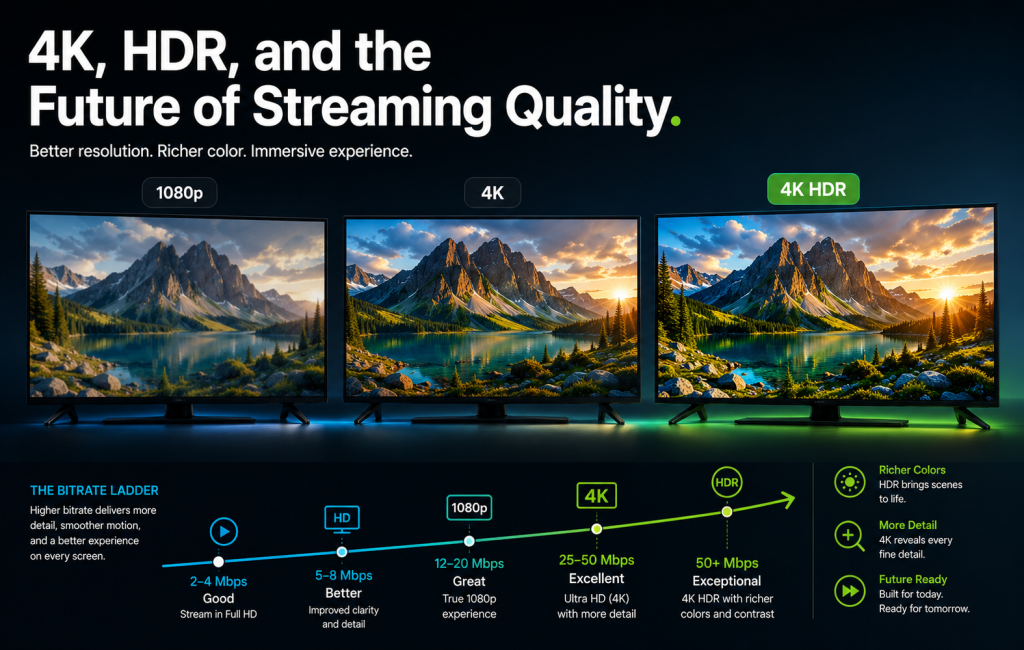
| Standard | Resolution | Color/Brightness | Typical Bitrate |
|---|---|---|---|
| HD (1080p) | 1920 × 1080 | 8-bit, SDR | 3–6 Mbps |
| 4K (UHD) | 3840 × 2160 | 8–10 bit, SDR | 15–25 Mbps |
| 4K HDR (HDR10) | 3840 × 2160 | 10-bit, wide gamut | 20–30 Mbps |
| 4K HDR (Dolby Vision) | 3840 × 2160 | 12-bit, dynamic metadata | 25–35 Mbps |
Resolution gets the marketing, but HDR is what viewers actually feel. Wider color gamut and higher peak brightness make sunsets look like sunsets and shadows hold real detail.
HEVC vs AV1 — The Codec Question
Codecs compress video. Better compression means better quality at lower bitrates — which means lower CDN bills and happier viewers on slower connections.
- H.264: The universal floor. Plays everywhere. Inefficient at 4K.
- HEVC (H.265): Roughly 40% more efficient than H.264. The current 4K standard. Widely supported on TVs and modern phones.
- AV1: Roughly 30% more efficient than HEVC. Royalty-free. Adoption is growing fast on smart TVs, browsers, and flagship phones — but not universal yet.
Bamboo Cloud transcodes to a smart codec ladder automatically — H.264 for compatibility, HEVC for 4K, and AV1 where supported. You don’t need to choose.
When 4K HDR Streaming Is Worth It
Not every catalog needs 4K HDR streaming. It’s clearly worth the bandwidth for:
- Cinematic content — films, premium documentaries, nature
- Sports — fast motion benefits from higher pixel counts
- Fitness and yoga — detail in form matters
- Faith broadcasts of high-production-value events
It’s often not worth it for talking-head webinars, podcast-style content, or older archive material where the source isn’t 4K to begin with.
The Bitrate Ladder Explained
A bitrate ladder is the set of quality renditions delivered via adaptive bitrate streaming. Bamboo Cloud’s default ladder for premium content looks roughly like:
- 240p — 400 kbps (fallback for very weak connections)
- 360p — 800 kbps
- 540p — 1500 kbps
- 720p — 3000 kbps
- 1080p — 5500 kbps
- 1440p — 9000 kbps (optional)
- 2160p (4K) — 18000 kbps
- 2160p HDR — 24000 kbps (when enabled)
Viewers automatically receive the best rendition their device and connection can handle. Quality scales up and down mid-stream without interruption.
Protecting Premium 4K Content
Studios and rights-holders typically require Widevine, FairPlay, and PlayReady DRM for licensed 4K and HDR delivery. If your roadmap includes premium licensed content, plan for DRM integration as part of the rollout — and budget accordingly.
How to Roll Out 4K HDR Streaming Without Breaking Your Budget
- Start with your tentpole titles, not the full catalog
- Enable HEVC and AV1 alongside H.264 in your transcoding profile
- Tag premium 4K HDR content visibly in the UI — viewers love to see it
- Monitor CDN cost-per-viewer to keep margins healthy
- Expand the 4K library as new content is produced
Ready to deliver premium quality on every device? Start your free trial and stream in 4K HDR this week.