


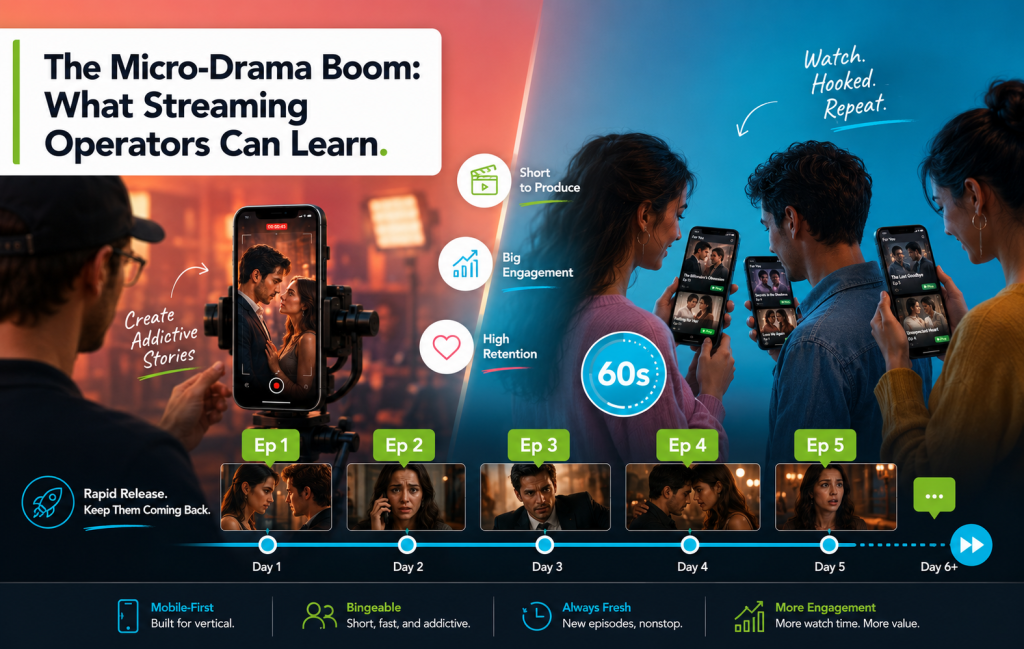
The Micro-Drama Boom Isn’t a Passing Trend
The micro-drama boom is one of the most surprising developments in streaming this decade. In China, apps like ReelShort, DramaBox, and GoodShort have built billion-dollar businesses out of 60-to-90-second vertical episodes strung together into long serialized dramas. Viewers pay per episode, unlock coins, and burn through 80 to 100 episodes over a few days. The format looks nothing like traditional streaming — but every OTT operator should be paying attention.
Here’s what the micro-drama phenomenon actually teaches, and how it applies to your platform whether you’re producing 60-second episodes or two-hour documentaries.
What a Micro-Drama Actually Is
A micro-drama is a scripted, serialized story told in short vertical episodes — typically 60 to 120 seconds each. A “season” can run 60 to 100 episodes. The format is designed for a phone in portrait mode, one thumb, and small windows of attention. Common genres:
- Romance (billionaire heir falls for underdog is a genre unto itself)
- Revenge dramas
- Family conflict and secret-identity plots
- Werewolf, vampire, and other supernatural romance
- Melodramatic thriller
Micro-drama audiences aren’t looking for prestige TV. They’re looking for the emotional payoff of a soap opera compressed into two minutes.
The Business Model Is What’s Really New
The micro-drama business model breaks the SVOD/AVOD template:
- First 8–12 episodes free to hook the viewer
- Paywall kicks in mid-story, at a cliffhanger
- Viewers pay per episode with coin bundles ($9.99, $19.99, $49.99)
- Some platforms allow AVOD unlocks — watch 3 ads to unlock the next episode
- Weekly subscriptions available at premium tiers
The result: ARPU numbers that look more like mobile gaming than streaming. Some viewers spend hundreds of dollars finishing a single micro-drama season.
Lesson 1: Vertical Video Is Winning on Mobile
The most portable takeaway from the micro-drama boom: mobile viewers strongly prefer vertical video for phone-first viewing. This isn’t specific to dramas. It applies to short-form promo content, series recaps, and micro-content across every OTT vertical. If you’re not producing vertical variants of your content for mobile, you’re losing engagement to competitors who are.
Lesson 2: Pacing Trumps Production Value
Micro-dramas are shot fast, edited faster, and have production budgets a fraction of traditional TV. But they win on pacing. Every 90 seconds hits an emotional beat. Every episode ends on a cliffhanger. Traditional TV writers spend three episodes building tension. Micro-drama writers build and release tension in every scene.
The lesson for every streaming operator: audiences on mobile don’t reward patience. They reward payoff.
Lesson 3: The Cliffhanger Is a Business Model
Micro-drama monetization works because the cliffhanger is engineered directly into the payment flow. Free episodes end on emotional peaks that make paying feel obvious. This principle — that content pacing should align with the monetization moment — applies broadly. Your trial’s free-preview period, your PPV teaser trailer, your AVOD ad break placement all benefit from the same discipline.
Lesson 4: Serialize Everything You Can
The micro-drama audience returns because they’re mid-story, not because they love the platform. Serialization drives daily-active-user retention in a way that a random content library can’t match. If your streaming platform has any content that could be structured as a series with cliffhangers, do it.
Lesson 5: Mobile Payment Friction Is a Solved Problem
The micro-drama boom proved that mobile viewers will happily buy coin bundles, unlock individual episodes, and pay premium prices for content — as long as the payment flow is invisibly smooth. Apple and Google in-app purchase, Stripe Elements, one-tap Apple Pay — none of these are new. But the micro-drama industry validated that friction, not price, is what kills mobile monetization.
Should You Produce Micro-Dramas?
For most OTT operators outside the pure drama market, the answer is no — you’re not competing with ReelShort. But you can borrow the playbook for your own content:
- Cut a vertical trailer for every long-form piece of content
- Serialize educational or documentary content into shorter, cliffhanger-driven episodes
- Test paywalls mid-series rather than at signup
- Speed up your pacing on mobile clips
- Cross-promote your long-form catalog inside your vertical shorts
What the Micro-Drama Boom Signals
Above everything else, the micro-drama boom tells you where streaming attention is heading: shorter, more vertical, more emotionally direct, and more transactional. The operators who study this format — even if they never produce it — will build better mobile experiences, better paywalls, and better content pacing.
Ready to build a streaming platform that meets modern attention? Start your free trial today and launch on every device this week.