

OTT Pricing Psychology: The Decisions Behind Every Paid Subscriber
OTT pricing psychology is the least discussed and most consequential lever in streaming. Most operators pick a price by looking at competitors and picking a similar number. That’s how you end up with $9.99 subscription tiers that convert at half the rate they could — because the price is right but the framing is wrong. Behavioral economics has spent decades studying how people decide what to buy. OTT pricing psychology is what happens when you apply that research to a monthly subscription decision.
Here’s what actually works.
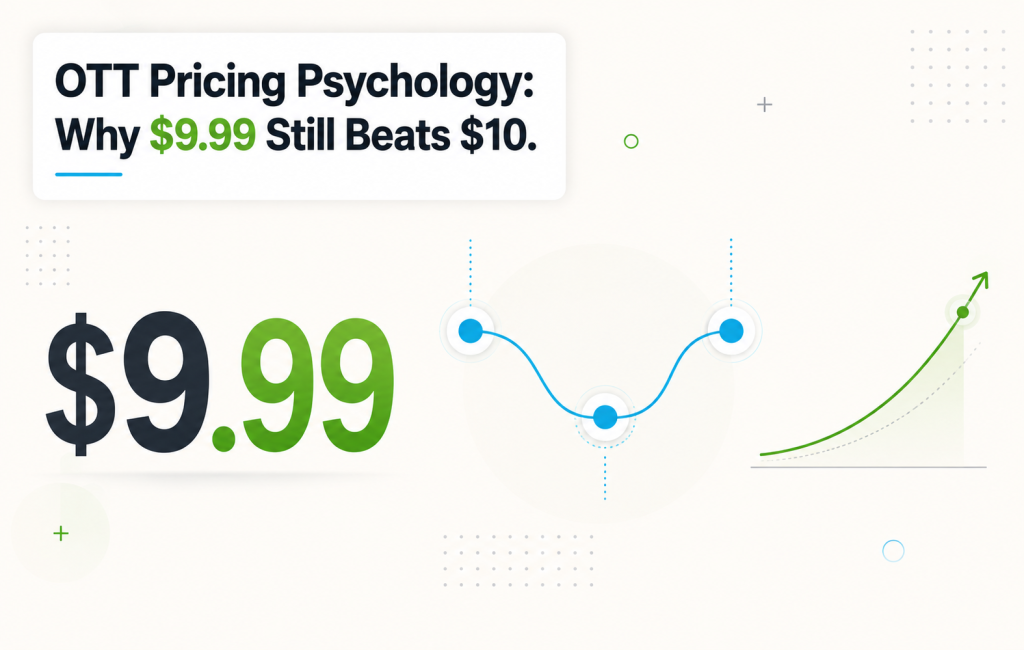
1. Why $9.99 Still Beats $10
The single most robust finding in pricing psychology: prices ending in .99 outperform round numbers, even when the difference is a single cent. It’s called charm pricing, and it works because the brain reads $9.99 as “nine dollars something” before it processes the full number. Netflix, Disney+, HBO Max, Apple TV+ — every major streaming platform prices in $x.99. There’s a reason.
If you’re currently priced at $10 or $15 or $20, moving to $9.99, $14.99, or $19.99 lifts conversion measurably. It’s the cheapest optimization in OTT pricing psychology.
2. Anchor Pricing: The Decoy That Sells the Middle Tier
Present a single price and buyers evaluate it in isolation. Present three prices and buyers evaluate them relative to each other. This is anchoring, and it’s the reason most successful streaming platforms use a three-tier structure:
| Tier | Purpose |
|---|---|
| Basic ($7.99) | Anchor — makes middle tier look like value |
| Standard ($12.99) | The tier you actually want people to pick |
| Premium ($19.99) | Anchor — makes middle tier look reasonable |
The premium tier isn’t there because you expect volume. It’s there to make the middle tier feel like the smart choice. Remove it and standard-tier conversion drops.
3. The Annual Discount Curve
Annual subscriptions retain subscribers roughly 2x better than monthly. Getting subscribers onto annual plans is one of the highest-leverage moves in OTT pricing psychology. The discount curve that works:
- 10% off annual: Feels like a rounding error, low uptake
- 15–20% off annual: Modest lift, still not compelling
- 25–33% off annual: The sweet spot — noticeably better than monthly
- 40%+ off annual: Optimal for retention, but leaves revenue on the table
Most platforms land at 25–33%. Frame it as “months free” rather than a percentage — “2 months free” feels more concrete than “17% off.”
4. Free Trials: Length Matters More Than Existence
A 7-day free trial converts to paid better than a 30-day trial in most OTT categories. Longer trials give users more time to forget they signed up, which increases voluntary cancellation and involuntary churn (expired card, forgotten renewal). Shorter trials create urgency.
The exception: premium content platforms where the value takes time to demonstrate (documentary streaming, education, faith formation). There, 14 to 30 days can work — but always with active nudges throughout.
5. Bundling and Feature Gating
OTT pricing psychology often comes down to what’s in each tier, not just the price. Effective feature gating:
- Number of simultaneous streams (1 / 2 / 4)
- Video quality (SD / HD / 4K)
- Downloads for offline viewing
- Ad-supported vs ad-free
- Access to premium originals or live events
- Number of user profiles
Gate what people actually notice. Nobody upgrades for a feature they can’t see they’re missing.
6. The Cancel Flow Is Part of the Price
The cancellation experience is where a huge amount of OTT pricing psychology plays out — and where most platforms leave money on the table. Effective cancel-flow tactics:
- “Are you sure? Here’s what you’ll miss” — surface unwatched content
- “Pause for a month” — retention instead of loss
- “Stay 3 months at 50% off” — the save offer
- “Tell us why” — feedback that informs product improvement
Save-the-sub offers recover 15–25% of would-be cancellations across most platforms. That’s real money.
7. Payment Frequency and Cognitive Load
Monthly billing feels smaller than annual billing, but shows up 12 times a year — every one an opportunity to cancel. Annual billing feels bigger up front but creates only one decision point per year. This is a core insight of OTT pricing psychology: reducing decision frequency reduces churn.
The rare exception: quarterly billing (every 3 months) — some platforms find this splits the difference well.
8. Price Increases: The Right Way to Do Them
Eventually every OTT platform raises prices. Handled well, price increases barely dent retention. Handled badly, they trigger cancellations. What works:
- Give existing subscribers 60+ days notice
- Grandfather the current price for a defined period (usually 3–12 months)
- Communicate what’s new — content added, features shipped — that justifies the change
- Offer a one-time incentive to switch to annual before the increase kicks in
What This Adds Up To
OTT pricing psychology isn’t a single lever — it’s a set of small decisions that compound. Charm pricing, anchor tiers, annual discount curves, trial length, feature gating, cancel-flow saves, payment frequency, price-increase handling. Get most of them right and you’ll outperform competitors who priced by comparison alone.
Ready to price your platform for growth? Start your free trial today and configure your subscription tiers with confidence.