

Smart TV Apps Are the Most Underused Channel in OTT
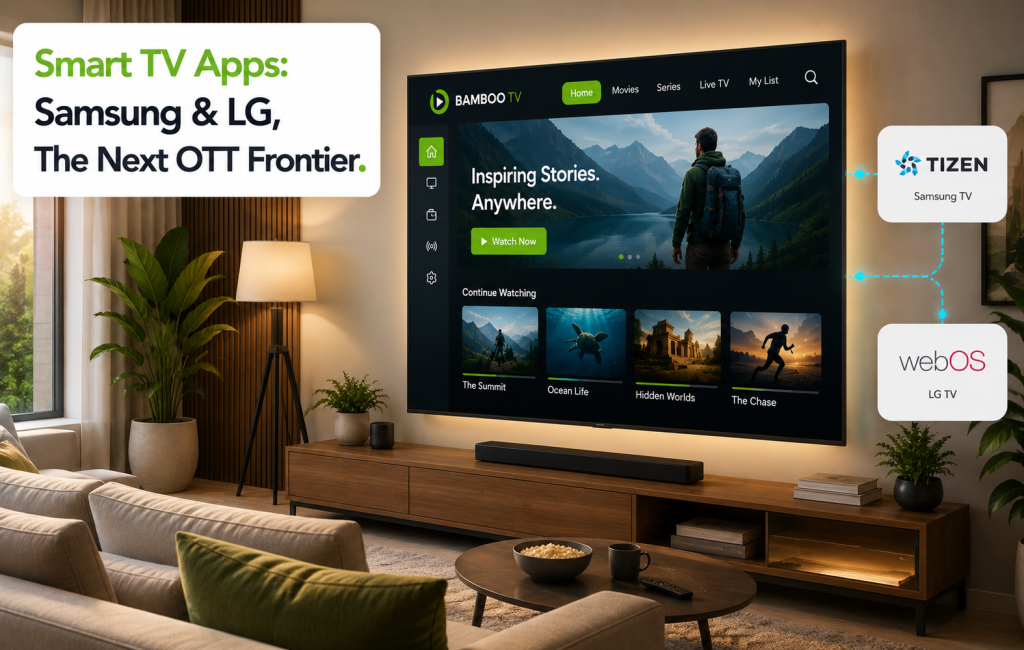
Smart TV apps on Samsung Tizen and LG webOS reach over 200 million households worldwide combined — and a striking number of independent OTT operators ignore them entirely. The conventional wisdom says Roku and Fire TV are the only TV apps worth building. The data says otherwise. Smart TV apps on the manufacturer-native platforms (Samsung, LG, Vizio) are increasingly where dedicated streaming viewers spend their evenings.
Here’s why smart TV apps are the next OTT battleground, and what it takes to win them.
The Smart TV App Market Is Bigger Than You Think
- Samsung Tizen: Over 200M smart TVs shipped globally. Tizen powers every Samsung smart TV since 2015.
- LG webOS: Roughly 100M households. webOS is also licensed by other manufacturers (Hisense, RCA, Polaroid).
- Vizio SmartCast: Strong U.S. footprint, ~30M households.
- Samsung TV Plus / LG Channels: The manufacturer-owned FAST aggregators are major distribution surfaces in their own right.
Compare that to Roku (~75M U.S. households) and Fire TV (~50M). The smart TV manufacturer ecosystem is larger by both reach and depth — but it’s harder to launch on, which is why most operators skip it.
Why Smart TV Apps Get Ignored
Three reasons most independent operators don’t ship smart TV apps:
- Submission friction. Samsung and LG have stricter QA processes than Roku or Fire TV. The review cycle is measured in weeks, not hours.
- Multiple SDKs. Tizen and webOS each have their own runtime and certification requirements. You can’t just port a Roku channel and ship it.
- Perceived lower priority. Operators see Roku and Fire TV stats and assume that’s where their audience lives, without testing the smart TV channel.
The result: less competition on the Samsung and LG storefronts, and higher install-to-paid conversion rates for the operators who do ship there.
Where Smart TV Apps Outperform
The viewers who use the manufacturer-native smart TV apps tend to be:
- Older households (45+) who never bought an external streaming stick
- International audiences in markets where Samsung and LG dominate (Europe, Latin America, parts of Asia)
- Heavy linear-TV viewers transitioning to streaming — the FAST audience
- Premium households who bought a high-end smart TV and use only its built-in apps
If any of those describe your audience, smart TV apps aren’t optional — they’re table stakes.
What It Takes to Launch Smart TV Apps
For most independent OTT operators, building Tizen and webOS apps from scratch is impractical. The shortcut: use a platform that handles the certification and SDK work for you.
Bamboo Cloud’s OTT Apps suite (on the Enterprise plan) covers iOS, Android, Roku, Fire TV, Apple TV, and Android TV from a single content library. Smart TV apps (Samsung Tizen, LG webOS) are available through partnerships — talk to the sales team about scope and timing.
The FAST Aggregator Opportunity
Samsung TV Plus and LG Channels are FAST aggregators built directly into millions of TVs. Distribution on these aggregators is one of the fastest ways to reach smart TV viewers without building a standalone app. It requires a deal with the aggregator and a Bamboo Channels FAST feed delivered to spec — but the reach payoff is substantial.
Smart TV Apps Strategy: Where to Start
- Confirm the audience fit. Check your existing analytics for the share of viewers on smart TVs vs sticks.
- Prioritize platform. Samsung Tizen first (largest install base), LG webOS second.
- Decide: app or FAST channel? A FAST channel on Samsung TV Plus or LG Channels often reaches more viewers, faster, than a standalone app.
- Plan for QA cycles. Allow 4–8 weeks for first submission and approval.
- Optimize the listing. Store screenshots, channel art, and descriptions matter as much on Tizen and webOS as they do on iOS.
Ready to reach the smart TV audience? Start your free trial today and talk to our team about smart TV app distribution.